



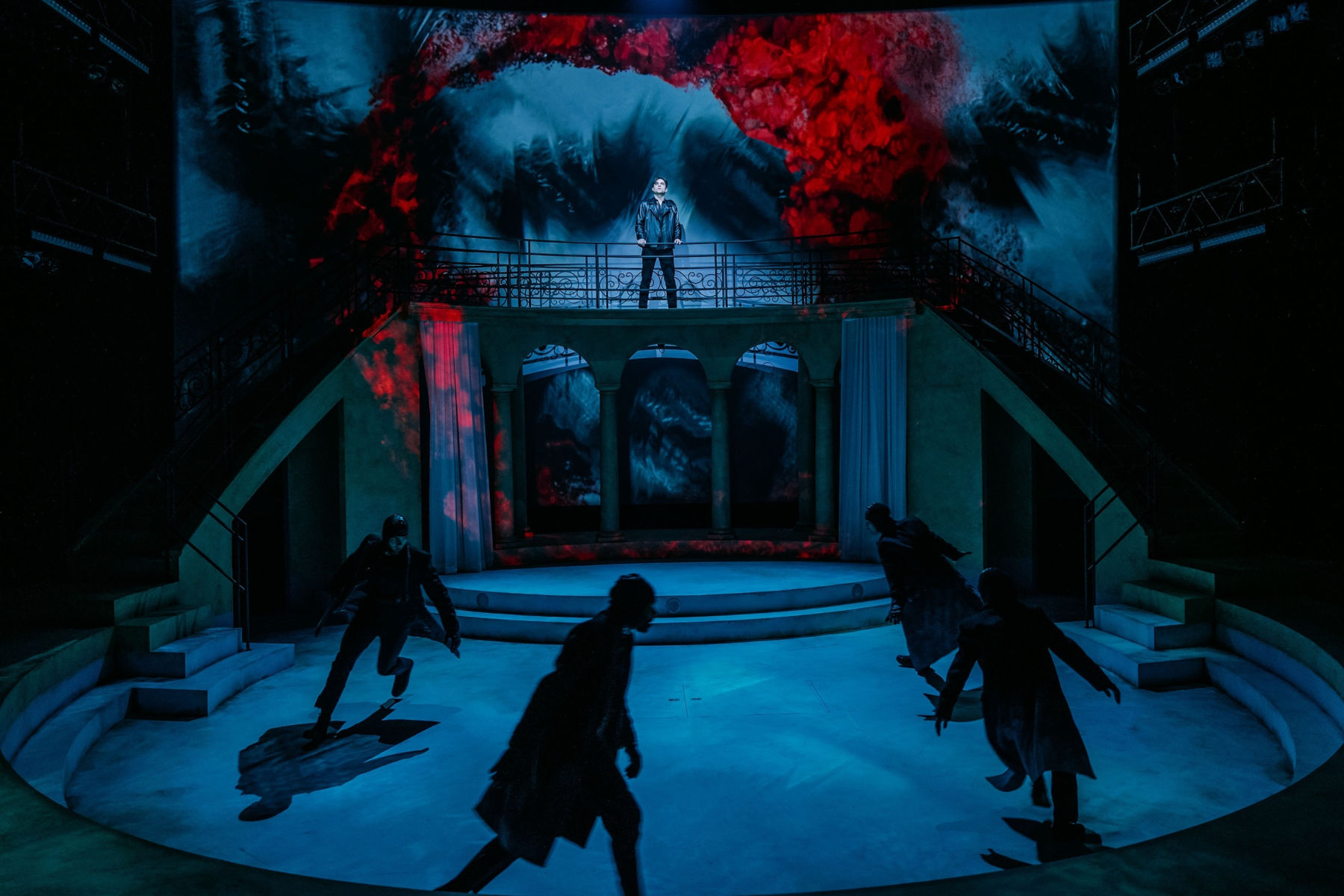
USA - A world-premiere modern adaptation of Hamlet recently wrapped at Center Theatre Group’s Mark Taper Forum in downtown Los Angeles. Adapted and directed by Robert O’Hara, this modern take on Shakespeare’s classic tragedy blended video, new scenes and characters, and a film noir aesthetic with lighting design by Tony Award nominee Lap Chi Chu. To help realise the show’s visual concept, Chu turned to Elation’s award-winning Paragon LED framing profile moving head.
Running from 28 May through 6 July, the production was boldly imaginative and anything but traditional. “The show was an adaptation that caught the spirit of Hamlet,” Chu commented. “It was a fun production, but very different.”
With a younger audience in mind, the creative team leaned into a stylised visual approach, and lighting played a central role. “We were looking to do something exciting and new,” Chu noted. “The lighting and design mandate was film noir, and I was looking for dynamic, single-source lighting to capture that feel.”
To bring the visual concept to life, Chu collaborated with Los Angeles-based Kinetic Lighting. Chu and Aaron Staubach, head electrician at the Mark Taper Forum who operated the show, were introduced to the Paragon through Kinetic along with Elation product application specialist Nick Saiki.
“Nick articulated well why the Paragon is different,” Chu explained. “What really stood out was CRI as an adjustable, fadeable parameter. No other fixture can do that. In the past, you had to rather ungracefully drop in a CRI filter, but Paragon gave us the ability to fade smoothly from one CRI value to another - going from looking great on skin for a front light special to cutting through space with greater firepower. That was very exciting to me as a designer and is a big advantage in live theatre.”
Staubach agreed: “My role is technical so I go to a lot of demos, and the difference between fixtures can be marginal. But when I heard about Paragon’s CRI adjustability, that was big for me as well. Being able to dial that in on a cue-by-cue basis, more punch one moment and adjust for skin tones the next, gives designers a lot more flexibility. As head electrician, being able to point out that feature to a designer is very exciting.”
Five Paragon M fixtures were used in overhead positions throughout the 739-seat space, providing coverage for the three-quarter thrust stage. Chu frequently uses shutter looks in his designs and found the Paragon well-suited for that. In one striking moment, a single Paragon fixture was used as a top light, cut into a rectangle to represent a grave, the only light on stage during the scene. “It was powerful, even in a tight shuttered look, with light bouncing off the set,” he said. “That one beam was central to the scene.”
Chu also appreciated other features of the fixture, including the prism effects and dual frost. “I always look for a good prism set, and the Paragon has that. It gives a softness and an undulating feel to the light, or we used it to make one light look like many quickly.” Often used for a strong singular backlight or shaft of light, Chu says the Paragon’s frost diffusion was used quite successfully when they didn’t want to see a hard edge.
The Paragon’s colour mixing system proved especially versatile in the show’s most dramatic transitions. The ability to shift to a bold, all-red look for the show’s final moments gave the lighting design added impact. “There is a scene at the end, very stylized, a death scene where everything bluntly turns to red – here we went from a white shaft of light to a signifying type of saturated red with the CMY system,” Chu said, calling it one of the production’s most striking effects.
Staubach concludes that the show went very well. “Although it wasn’t a traditional version of Hamlet, it was well received and people walked away with a good evening of theatre.”