



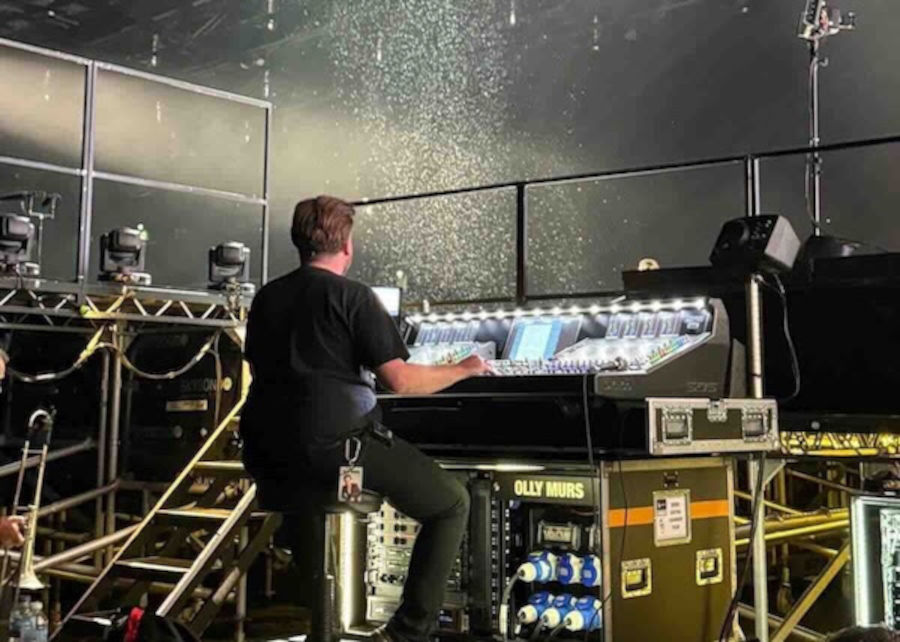
UK - Olly Murs shows are non-stop. Keeping up requires the flexibility and power of a DiGiCo console, so Rob Sadler at the front-of-house position and John Lumsdon on monitors both chose the Quantum 5, supplied by Solotech, for Olly’s epic tour, including his O2 Arena dates in May.
The engineers joined Olly Murs a little over a year ago but, as Rob Sadler explains, their relationship with DiGiCo consoles began much earlier.
“I first used a DiGiCo in 2011, and I’ve used them on almost every tour I’ve done since 2015,” he recalls. “It is definitely the console I feel most comfortable behind and most things are now second nature. I’ve been on tour with Olly for about 16 months and it’s been a lot of fun. It’s what I’d class as a proper pop music concert. There are pyrotechnics, confetti and automated staging, there’s even snow!”
The show is a huge audio and visual spectacle, and fans get super excited as the anticipation for Olly’s entrance builds. Delivering the intelligibility required to push through the noise-floor is something that Sadler works hard on, as he continues:
“The show typically starts with a lot of excitement as the intro-video rolls, then thousands of screaming fans join in as Olly appears on stage!” he says. “I don’t tend to make many adjustments to the mix during the show, just the odd fader ride for guitar solos, horn solos and key BV lines. I’m also using Snapshots on each song for muting and sending MIDI signals to the outboard reverb units. My main focus throughout is vocal impact and intelligibility. Olly wants the crowd to have a great night, so he also tells a lot of stories between songs. I use Macros to change the Naga 6 between my ‘singing’ and ‘talking’ presets to make sure every word is understood. It’s something that I couldn’t do the gig without now.”
When a show is fast paced and unpredictable, the last thing engineers want to waste time doing is scrolling through layers, or trying to find features. The DiGiCo Quantum 5 surface benefits from three 15-inch full colour TFT-touchscreens, with 37 physical faders across three banks, ensuring everything is exactly where you want it.
“I chose the Quantum 5 because I like the layout of the console,” Sadler continues. “My entire show is laid-out over the first two layers, so it’s all just one button-press away. This is my first time touring a Quantum console and I feel like I haven’t gone as deep as I could have with the Mustard channels, but it’s something I’ll definitely try out in the future, along with the v20 updates. I’m looking forward to trying the MSE [Mustard Source Expander] and seeing how it compares to similar analogue units.”
At the monitor position, John Lumsdon is also using a Quantum 5. He has used DiGiCo consoles since 2017 because of the flexibility of routing and familiarity of the console layout. It has been a huge help on this tour; every show starts with a bang and doesn’t let up, so having a console that responds quickly is a massive bonus.
“It's a big impact start and it’s been really good fun working alongside great musicians and a really strong crew. The show itself is jam packed, exciting, all action, with a feel-good vibe,” he says. “With 10 band members and Olly I need to keep an eye over the whole stage, so looking down at the console isn't an option. The Snapshot and Matrix features make everything so smooth and easy. We have lots of different parts to the show where new instruments come in and others go off-stage, so we can make transitions seamless without disrupting the workflow.”
Lumsdon is responsible for the monitor mixes, all delivered via in-ear monitoring, not just for Olly and the band, but also for tech and stage management, a total of 16 wireless IEMs and a further four hardwired units. There are also sub-bass loudspeakers onstage to give a tactile response for the drum, bass and keyboard players. With so much going on, an intuitive workflow is key to a trouble-free show, but staying in the digital domain has also given Lumsdon the edge when delivering great mixes.
“It’s always important from a monitor point of view to get the vocals to have the correct impact in the ears. Using a digital radio mic AES output directly into the SD Rack and running at 96K helps to cut latency down to a minimum. That, combined with the 32-bit outputs, really starts the mix off right,” he explains. “When new instruments come in and others go off-stage, we can make transitions without disrupting the workflow.”