



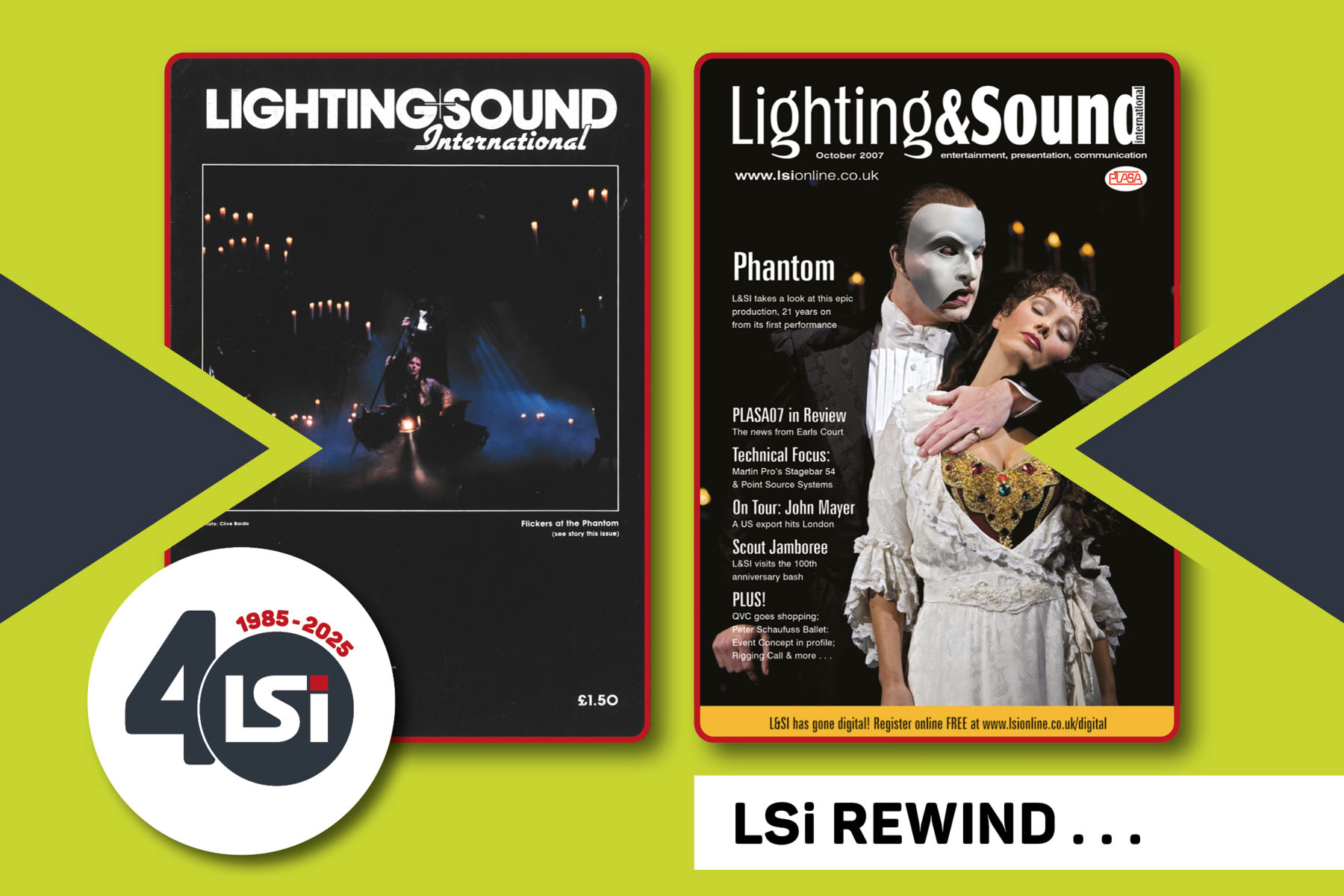
UK - As part of LSi's 40th anniversary celebrations, we'll be taking a tour through the archives at our coverage of various shows and productions over the decades. First up, a musical that launched at around the same time as LSi, and is still going strong! When Andrew Lloyd Webber’s Phantom of the Opera debuted at Her Majesty’s Theatre in London’s West End in October 1986, reviewers raved about its spectacular stage effects. These included “a thousand candles arising from a subterranean lake and a ‘gas lit’ recreation of the Paris Opera House of the 1870s”.
Having itself launched just a year earlier – in November 1985 – LSi ventured backstage to meet the creatives responsible for that fascinating flicker effect; something we might not think twice about today, but which was as magic as Paul Daniels back in the ‘80s!
In the Nov ‘86 edition, we met with LD Andrew Bridge and Action Lighting’s David Morgan, and took a tour of Morgan’s “Aladdin’s cave of lighting effects”.
As John Offord reported for LSi, the effect sparked into life when Robert Clutterman created a flickering candle effect using a PP3 battery and an electronic timer, switching power between two bulbs moulded in resin to the shape of a candle flame.
This concept was taken on by Action Lighting and, for Phantom, a more powerful model was developed by technician Christopher Clark and demo’d to production electricians Howard Eaton and Mike Odam.
The next challenge was to make the technology look the part in terms of scenic art. Needless to say, the team skilfully achieved this and even went on to install the effect in the lanterns mounted outside the venue!
Fast-forward . . .
Our next substantial trip behind the scenes of Phantom was in the October 2007 edition, when we reported on tech upgrades to the then legendary musical hit as it celebrated its 21st anniversary.
For her report, Sarah Rushton-Read looked at backstage expertise employed for the original ‘86 production, sharing how it had developed – or indeed, remained – in the ensuing years. She reconnected with Howard Eaton, who said at the time: “My business was practically born from my work on Phantom. Pretty much all of the electrical props for the original London show were built in the basement of the theatre, the dry ice machines were made in my garage at home!”
Sound designer Martin Levan also shared his insights: “This was an era when a lot of invention was required to move theatre sound forward. Very few manufacturers were actually developing products specifically for theatre, so we had to grab a bit from broadcasting, some more from recording, and some from the live concert sectors.”
Phantom sounds . . .
More recently, we visited the Phantom’s lair once more in the October 2019 edition, when we reported on the show’s recent audio upgrade. Over the years the show had survived the move from VHF to UHF radio mic systems; a switch from its long-serving Cadac A-Type analogue desk to a Yamaha PM1D and then a DiGiCo SD7T, and multiple upgrades to the venue’s PA system . . . now it was time for a RF microphone refit, which brought Sennheiser’s Digital 6000 system to the Masquerade!
40 years of LSi . . .
For these and other fascinating stories of theatre history and development, check out our full 40-year archive of back issues via the link below! Whether you’re studying, reminiscing or researching (or perhaps just a tech enthusiast!), it’s a valuable resource that we’re proud to share.
The LD Andrew Bridge will be joining the team on the Classic Gear Live stand at this year's PLASA Show (7-9 September, Olympia, London) on Monday 8 September at 3pm, with his original lighting plan for Phantom of the Opera to discuss this and other shows. You won't want to miss it!