



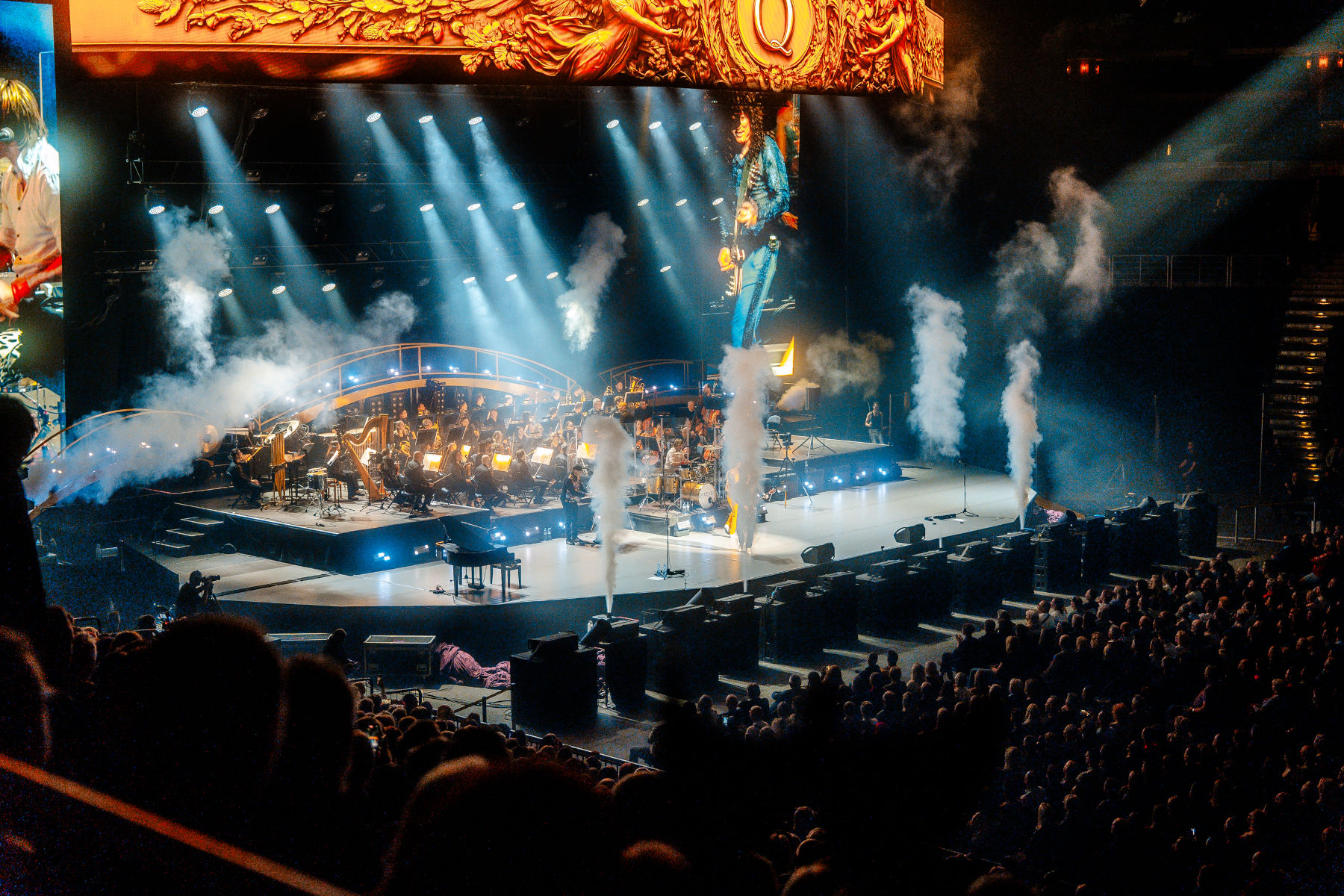
Czech Republic - L-Acoustics L-ISA Immersive Hyperreal Sound technology was deployed by Czech certified partner Pro Music across two sold-out nights at Prague's O₂ Arena this May. The sound supplier was Pink Panther, a major Czech touring company and L-Acoustics K2 partner. Queenie Relived: The Philharmonic delivered sonic integration to 30,000 fans.
Since 2006, Queenie have earned international recognition for their uncompromising authenticity, performing more than 1,400 concerts worldwide, including seven previous sold-out O₂ Arena shows, appearances at the Montreux Jazz Festival, and even Queen Elizabeth II’s official celebration. But collaborating with the Janáček Philharmonic Ostrava presented their biggest technical challenge yet.
"Traditional stereo reinforcement would have forced us to choose either the orchestra gets buried under the rock mix, or the rock loses its punch," explains Daniel Krčmář, CEO of Pro Music. "L-ISA gave us a third option - spatial separation that lets both elements exist at full intensity without compromise."
The breakthrough came through L-ISA's object-based approach. Rather than fighting for the same sonic space, each orchestral section was positioned and amplified to preserve its natural timbre, then distributed spatially across the system. Meanwhile, Queenie's rock elements maintained their characteristic power and punch through dedicated positioning.
Using L-Acoustics Soundvision 3D simulation, the Pro Music team pre-modelled the O₂ Arena's acoustics to optimise coverage and predict the balance between orchestral clarity and rock power - critical for a venue where every seat needed identical immersive impact.
Pro Music's deployment centred on five hangs of 18 K2 line array speakers across the stage, forming the main Scene system. To create width and depth, two extensions of 21 Kara II per side provided a wide soundscape, while a further out-fill hang of 15 Kara II per side ensured complete coverage for the vast arena.
Low-end energy came from two centre-flown arrays of 10 KS28 each, reinforced by eight ground-stacks of KS28 pairs in cardioid, with 15 Kara II for spatial front-fill, delivered full-range sound with localisation. Processing was managed by the L-ISA Processor II running on a Milan- AVB network, with amplification via partially flown LA-RAK II units.
The team also expressed their gratitude to L-Acoustics application engineers Thomas Mehlhorn and Christian Schmid, whose on-site expertise and guidance were invaluable in ensuring the system performed flawlessly. “They supported us all perfectly, and we owe them a big thank you,” added Krčmář.
The spatial design allowed audiences to distinctly localise every instrument - from screaming electric guitar solos to delicate woodwind phrases - while experiencing them as a single cohesive performance. Each orchestral section retained its classical character while supporting, rather than competing with, the band's rock energy.
“L-ISA allowed us to build layers of sound with clarity and precision,” continues Krčmář. “The audience felt the rock energy at its full intensity, but heard the orchestra as an essential performance element, not just background music. That created true audio immersion - that would be impossible with a traditional stereo system.”