



UK - For a popular visitor attraction devoted to celebrating the UK’s automotive land speed records since the post-World War One era, the importance of dynamic audio support for arresting visual story telling is crucial to delivering a memorable experience.
The Pendine Museum of Land Speed on the South Wales coast, which offers a series of classic AV presentations based on historical themes in extreme motor sports, delivers the dramatic sights and sounds of powerful and highly tuned racing vehicles. Visitors can witness the sheer exhilaration of extraordinary high-speed record achievements set against a background of a completely natural and serene coastal environment: a seven-mile stretch of the Pendine Sands.
The emotive soundtracks that accompany these arresting wide-screen videos are confidently reproduced by K-array’s smallest line array speakers, coupled with compact stand-alone subwoofers providing the meaningfully energetic low frequencies.
One of the main challenges for New Forest-based AV systems integrator D J Willrich to fulfil the technical brief was that of aesthetic integration. The museum required that the audio solutions should provide a stereo image for each of the super-wide wall-mounted video screens, and seamlessly blend in with the structures of the exhibits – without being obtrusive or detract from the visuals which dictate the historical ambience of the space, but just reinforce the video content. Furthermore, the brief also called for the loudspeakers not to be seen at all.
“Many of our museum clients typically don’t like to install highly visible, boxy speakers, and prefer an uncluttered, more streamlined appearance of modern AV technology around their exhibits,” said D J Willrich director Josh Miller, “and that’s why the K-array speakers work so well in this environment. They are completely invisible, and yet the coverage is excellent and they sound huge.”
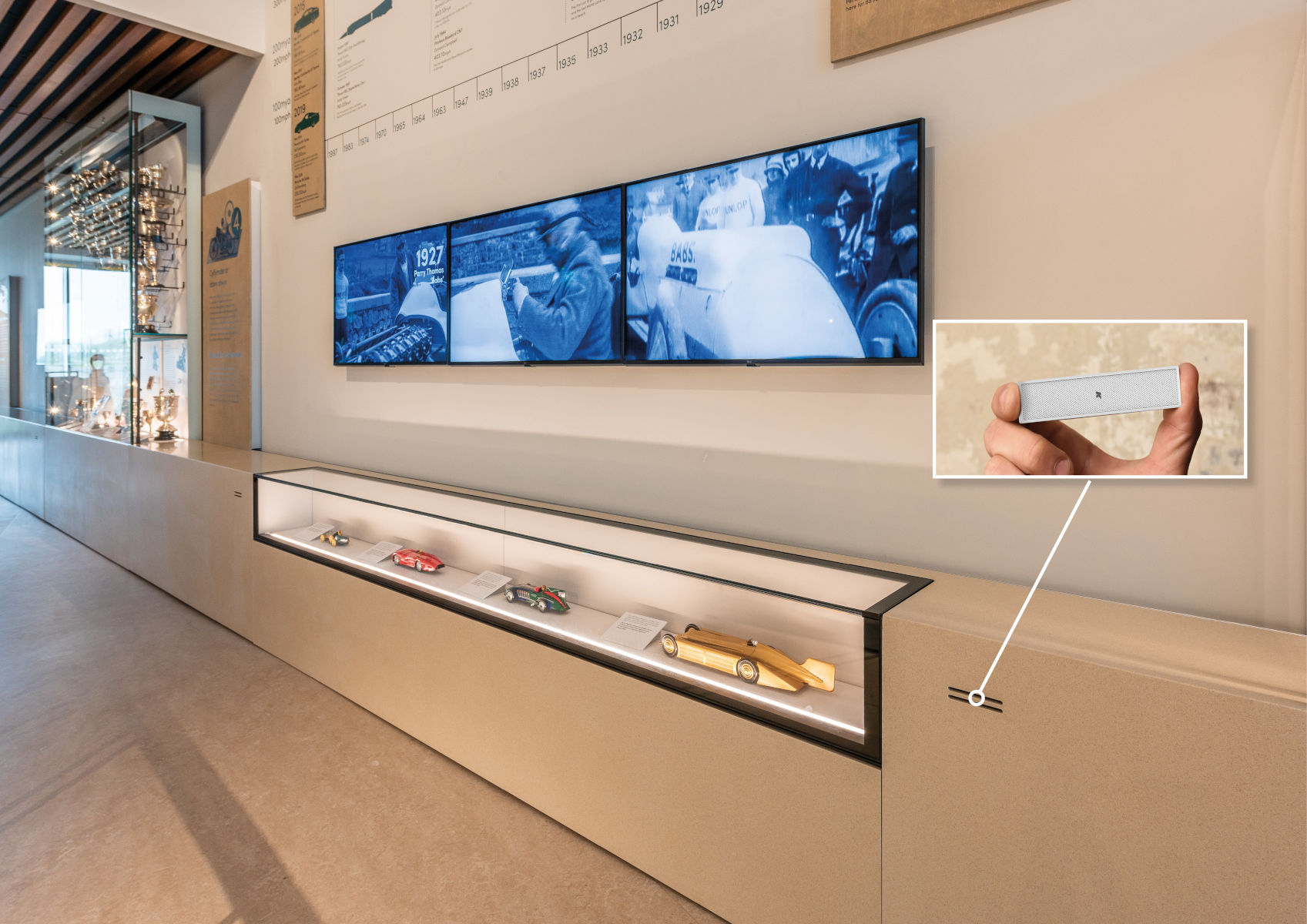
DJW’s solution was to locate the ultra-micro Lyzard-KZ14 line arrays behind the fascias of the exhibits, so that it’s not immediately obvious exactly where the sounds that accompany the footage of the feats of John Parry-Thomas and his contemporaries are actually coming from – the only clue as to their location being the pair of subtle horizontal slots machined out of the continuous Corian exhibit housings.
The horizontal orientation of the 10cm long line arrays results in a fairly wide 140° vertical coverage pattern that caters very well for a range in height of visitors from children to adults, while the 40° horizontal dispersion effectively avoids overspill of sound between adjacent exhibits.
The omni-directional output from the Truffle-KTR25 subwoofers concealed within the exhibits, and equipped with a pair of 5.25” low-frequency drivers (one driven and one passive), reaches down to 45Hz and emanates from the deliberate horizontal reveals at the bottom of the exhibits, bringing to life the pulsating rhythms of high-speed engines and deep bass impact.
Each of the individual audio systems is powered by a Kommander-KA02 compact four channel Class D amplifier connected directly to the dedicated HD video player, and configured by onboard DSP to drive both the small line arrays and the subwoofer for each exhibit. This results in minimal cable runs and easy control and automation of the content via a centralised control PC running Showmaster software.
The quality of the audio delivery has certainly made an impression on visitors, according to commercial operations manager Andrew Sellick: “The museum’s only been open since the end of May, and remarkably for this relatively out of the way part of South Wales we’ve already seen around 5,000 visitors, that’s over 150 a day. They’re clearly impressed with the clarity and range of the soundtracks and how well they convey the visceral excitement of these extraordinary high-speed achievements.
“In terms of after sales support from DJW, it's been superb. They always answer the phone, and any technical issues that we may have are resolved straight away. And even at weekends I've sent email on a Saturday night and got a reply first thing Monday morning at half past eight, which is fantastic!”